Inter-site federation mesh
Most real organizations are not one building. AuroraSOC runs a complete, autonomous SOC at every site and connects the sites in an encrypted mesh, so each location keeps protecting itself even when its link to the rest of the organization goes down.
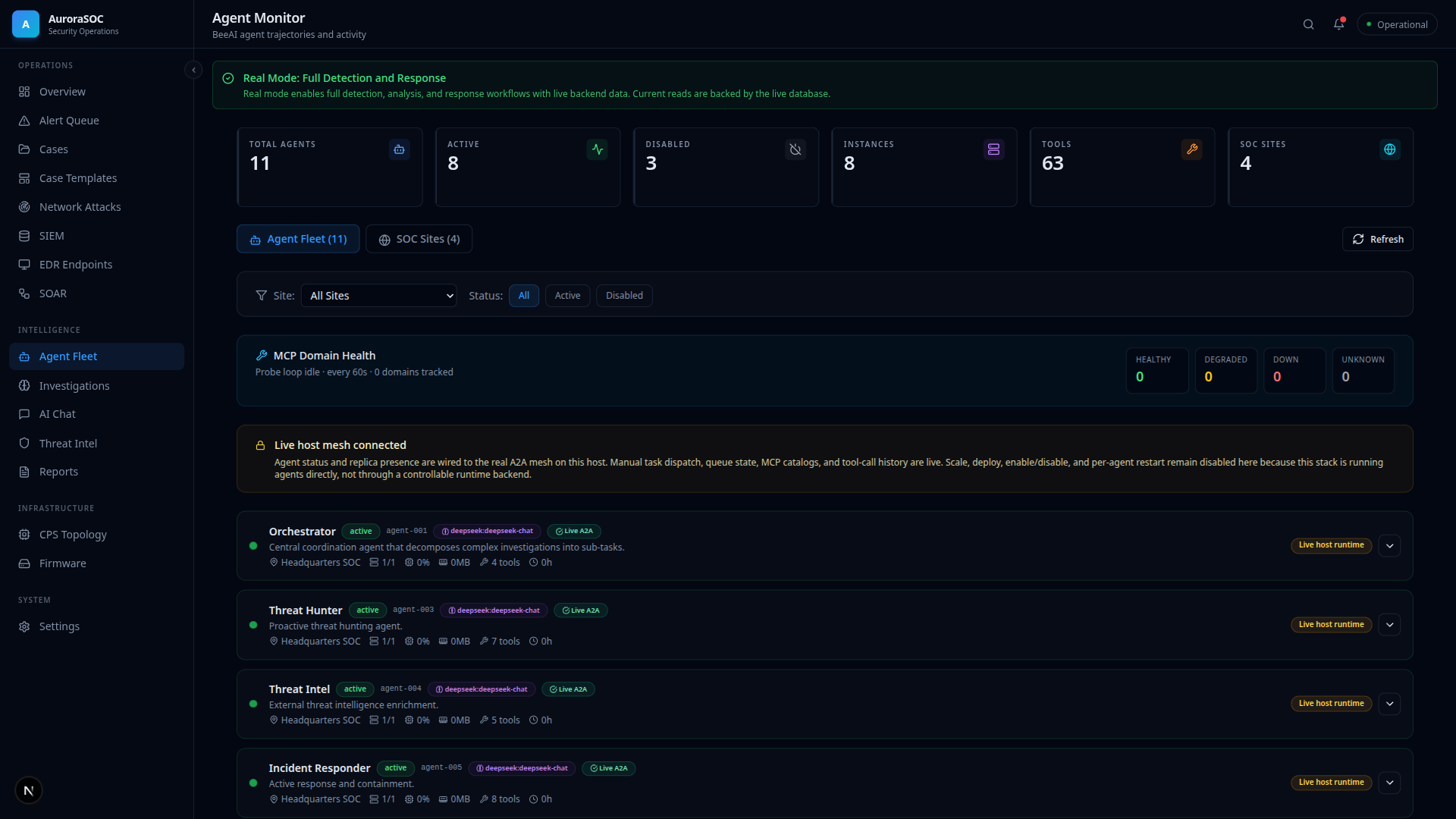
How the mesh works
Sites attach to each other at the messaging layer: each site's NATS server connects to the primary site as a leafnode, so any event published at one site reaches every peer while each site keeps its own local stores. There is no central broker to lose.
Two kinds of traffic cross the mesh:
- Health gossip. Every site publishes a heartbeat
(identity, tier, agent counts) on a fixed interval. Peers use the
heartbeat age to derive live link state -
healthy,degraded, ordown- which is exactly what the SOC Site Topology map on the Agent Fleet page renders. - Federated alerts. Alerts at or above the configured severity
floor (
highby default) are stamped with their origin site and shared with every peer. They arrive in the receiving site's alert queue with a purple origin badge (for examplesite-b), already deduplicated against replays.
Partition tolerance
A site that loses its mesh link keeps detecting, investigating, and
responding with its local policy - nothing about the local loop
depends on the mesh. The topology map marks the link down and
the peer site offline; when connectivity returns, gossip resumes
and the map heals on its own.
Enabling federation
Federation is off by default. On each site set:
FEDERATION_ENABLED=true
FEDERATION_SITE_ID=site-b              # unique per site
FEDERATION_SITE_NAME="Branch SOC - Cairo"
FEDERATION_SITE_TIER=secondary
FEDERATION_FEDERATE_MIN_SEVERITY=high  # what is shared with peers
For the development two-site demo, just stack-up-site-b brings up a
complete second site (its own Postgres, Redis, and a NATS leafnode)
beside the primary stack; just migrate-site-b prepares its
database. See ADR 029 for the design and its deliberate limits
(policy distribution and cross-site case handoff remain with the
future federation controller).